
So you’re standing at a crossroads. Maybe your Hero 12 is sitting right in front of you and you’re wondering if the Hero 13 is worth the extra spend. Or maybe you’re buying a GoPro for the first time and just want to know which model makes more sense without getting lost in spec sheets.
Either way, I’ve gone through tons of real user reviews, forum discussions, hands-on tests, and comparison videos to give you a straight answer. No padding, no fluff.
Let’s get into it.
Quick Summary: Who’s This For?
GoPro Hero 13 is for you if:
- You want GPS tracking built in
- You’re excited about swappable lens mods (macro, ultra-wide, anamorphic, ND filters)
- Longer battery life and better heat management matter to your shoots
- You do content creation seriously and want more creative control
GoPro Hero 12 is still perfectly fine if:
- You’re on a tighter budget and can find it at a discount
- You just want solid 4K/5.3K action footage without needing extras
- You already own GoPro batteries and accessories
- Casual use is all you need
Real-World Feel: Using Both Cameras
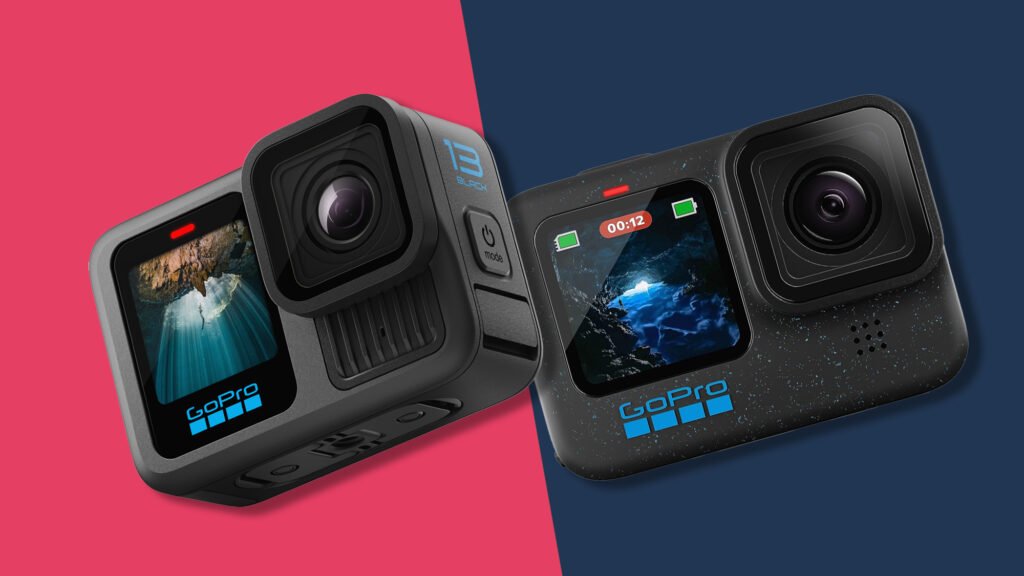
Here’s something most spec comparisons miss. When you actually hold a Hero 13 and a Hero 12 side by side, they feel almost identical. Same compact, rugged shape. Same general layout. GoPro didn’t reinvent the box. And honestly, that’s fine.
But after spending time with both, the Hero 13 feels more finished. The return to a clean black design (the Hero 12 had a speckled look that divided opinion) makes it feel a bit sharper. There’s a new heatsink sitting below the front lens, which looks slightly unusual at first but you quickly forget it’s there.
The magnetic latch mounting is a genuine quality-of-life upgrade. Swap the camera between mounts in seconds, one-handed. No fumbling. If you do a lot of active shooting where you’re constantly repositioning the camera, you’ll notice the difference almost immediately. One reviewer who tested it on mountain biking trails noted it feels notably more secure than typical magnetic mounts, and field reports generally back that up.
One small complaint from forum users though: the magnetic mount can pick up bits of sand and dirt that are surprisingly annoying to clean. Worth knowing if you’re regularly shooting at the beach or dusty trails.
Video Quality: Is There a Difference?
To be honest, this is where things get a little underwhelming for Hero 12 owners thinking about upgrading.
Both cameras shoot at 5.3K at 60fps. Both use the same sensor. GoPro didn’t swap in a new chip for the Hero 13, which was probably the biggest criticism the camera received at launch. In normal daylight conditions, shooting side-by-side footage from both cameras and looking at them on a regular monitor, most people genuinely cannot tell them apart.
Low-light performance is essentially the same. The sensor didn’t change, so neither did the output in challenging lighting.
Where the Hero 13 pulls ahead on paper is slow motion. It goes up to 400fps at 720p (the Hero 12 tops out at 240fps at 2.7K). If you’re into super slow-mo action shots, that’s a real advantage. It also supports 5.3K at 120fps for a solid five seconds, which is impressive for burst moments.
Both cameras also use HyperSmooth 6.0 stabilization. Yes, both. Some earlier comparisons said the Hero 13 upgraded to a newer version, but multiple detailed technical breakdowns confirm they’re on the same stabilization system. It’s already excellent, handling rough terrain and bumpy rides very well.
The Lens Mods: The Real Reason to Choose Hero 13
Here’s where it gets interesting. GoPro quietly made the Hero 13 into something its predecessors never were: a modular camera.
The Hero 13 has a new lens mount that accepts the HB-Series lens accessories. Ultra-wide (177-degree field of view), macro (focus as close as 4.3 inches), ND filters for cinematic motion blur, and an anamorphic lens for that widescreen cinematic look. What makes this actually useful rather than just a marketing feature is the auto-detection. Snap a lens on and the camera recognizes it, adjusts settings automatically. The ND filters even guide you to the right filter strength based on available light.
For content creators, especially anyone who shoots outdoor travel, nature close-ups, or wants cinema-style footage, this is genuinely exciting. Real users who’ve tested the ND filter system mention getting the correct motion blur settings almost perfectly on the first try without manual fiddling.
The catch: the lenses cost extra. The Macro Mod is around $130, Ultra-Wide around $100, the ND filter pack around $70. Buy them all and you’ve essentially doubled the cost of the camera. Also, none of these HB-Series lenses work on the Hero 12. The Hero 12 only has the Max Lens Mod 2.0 as its lens option, which gives a similar ultra-wide field of view but without auto-detection and the other creative options.
Also Read Best GoPro ND Filter Budget India Picks Under ₹1000: Real Talk for Serious Shooters
Battery Life and Overheating
The Hero 12 had a 1720mAh battery. The Hero 13 steps that up to 1900mAh, and combines it with a redesigned battery enclosure and a heatsink for better heat dissipation.
In real-world testing, the difference is noticeable but not dramatic. At 4K 60fps with airflow, you get roughly 87-88 minutes compared to around 81 minutes on the Hero 12. Not a revolution. However, in enclosed situations like mounting the camera inside a car or in conditions where heat builds up fast, the gap widens quite a bit. Shooting 2.7K at 100fps, for example, jumped from around 38 minutes on the Hero 12 to over 60 minutes on the Hero 13.
For extended recording sessions in warm conditions, this matters.
One thing that genuinely irritates existing GoPro owners: the new Hero 13 battery is not backwards-compatible with older models. If you have a collection of Hero 12 (or older) batteries, none of them will work in the Hero 13. This was a genuine source of frustration in forums, with one longtime GoPro user noting they had stacks of batteries from previous generations that became instantly useless.
GPS Is Back
The Hero 12 famously dropped GPS. GoPro brought it back for the Hero 13.
For most casual shooters, this probably doesn’t matter much. But if you track your routes, want speed data overlaid on your videos, or geotag your footage for travel content, it’s a useful feature. The Quik app can display GPS data overlays, showing speed, path, altitude, and G-force. Mountain bikers, skiers, and surfers who like to analyze their sessions will find value here.
Wi-Fi 6 and File Transfers
Slightly under the radar but genuinely handy: the Hero 13 upgrades to Wi-Fi 6, which delivers roughly 40% faster transfer speeds compared to the Wi-Fi 5 on the Hero 12. If you shoot a lot of footage and regularly transfer files to your phone or laptop, this actually adds up over time.
Audio Improvements
The Hero 13 adds new audio tuning options, including a Voice mode that boosts vocal clarity while still capturing ambient sound. For vloggers or anyone doing on-camera commentary during action, this is a small but appreciated upgrade. The Hero 12 had Bluetooth and AirPod support but didn’t have this kind of voice optimization.
One criticism worth mentioning: there’s still no built-in wireless microphone support. For anyone hoping to pair a lavalier wirelessly, that’s still not happening natively on either camera.
Pros of the GoPro Hero 13
- GPS tracking is back and works well
- Magnetic latch mounting is genuinely useful in fast-paced situations
- HB-Series swappable lenses open up creative possibilities no previous GoPro had
- Better battery life especially in restricted/hot environments
- Improved heat dissipation with new heatsink
- Burst slow-mo at 400fps is impressive
- Wi-Fi 6 for noticeably faster file transfers
- HLG HDR video support for better highlight/shadow retention
- Cleaner black design
Cons of the GoPro Hero 13
- Same sensor as Hero 12, so no improvement in base image quality or low light
- New battery is not compatible with older GoPro batteries
- HB-Series lenses are sold separately and can add up to the same price as the camera
- The magnetic mount can attract sand and dirt
- Lens mods are exclusive to Hero 13 (none work on Hero 12)
- HyperSmooth stabilization is unchanged from Hero 12
Pros of the GoPro Hero 12
- Same excellent 5.3K video quality as the Hero 13 for everyday shooting
- Typically available at a lower price after the Hero 13 launch
- Uses the same batteries as Hero 11 and Hero 10 if you have a collection
- HyperSmooth 6.0 stabilization still among the best on any action camera
- Solid choice for casual or beginner users who don’t need lens mods or GPS
Cons of the GoPro Hero 12
- No GPS
- No lens mod ecosystem
- Wi-Fi 5 means slower file transfers
- No burst slow-mo above 240fps
- No magnetic latch mount (requires separate accessory or older mount system)
- No HLG HDR
How It Compares to the Competition
A quick note here. DJI’s Osmo Action 4 remains a strong competitor, particularly for low-light shooting. It has a larger sensor and punches harder in dim conditions than either the Hero 12 or Hero 13. If low-light performance is your top priority and you’re not invested in the GoPro ecosystem, the Osmo Action is worth a look.
That said, GoPro’s overall ecosystem, mounting options, and the new lens mod creativity on the Hero 13 keep it competitive for creative video work. The Hero 13’s lens system is something DJI simply doesn’t have at this level.
FAQs: GoPro Hero 13 vs Hero 12
Q1. Is the GoPro Hero 13 worth upgrading from Hero 12?
If you’re coming from the Hero 12, the honest answer is: it depends on what you shoot. If GPS, the new lens mods, or the improved battery in hot/enclosed conditions matter to you, yes. If you just want great 4K action footage and you’re happy with your current setup, the Hero 12 will keep delivering for years. The core video quality is essentially the same.
Q2. Do the new lens mods on the Hero 13 work with the Hero 12?
No. The HB-Series lenses (Ultra-Wide, Macro, ND filters, Anamorphic) are designed exclusively for the Hero 13 Black. The Hero 12 only works with the Max Lens Mod 2.0, which offers a wide field of view but without the auto-detection and other creative options.
Q3. Are Hero 12 batteries compatible with the Hero 13?
Unfortunately no. GoPro introduced a new 1900mAh Enduro battery for the Hero 13 that is not backward-compatible with the Hero 12 or older models. The Hero 13 battery also won’t work in older cameras.
Q4. Which GoPro is better for slow-motion video?
The Hero 13 wins this one clearly. It can shoot up to 400fps at 720p, giving you 13x slow-motion playback. The Hero 12 tops out at 240fps at 2.7K for 8x slow-motion. For fast action like skateboarding, surfing, or motorsports where frame-perfect slow motion matters, the Hero 13 has the edge.
Q5. Does the GoPro Hero 13 have better stabilization than the Hero 12?
Both cameras use the same HyperSmooth 6.0 stabilization. There is no meaningful difference in stabilization between the two models. Both produce very smooth footage in active conditions.
Q6. What is the price difference between GoPro Hero 13 and Hero 12?
The Hero 13 launched at $399.99. After its launch, the Hero 12 dropped in price and can often be found for significantly less through retailers. If budget is a factor, checking current pricing on both is worthwhile since the gap can be meaningful.
Final Verdict
If you’re buying a GoPro for the first time or upgrading from something older than the Hero 11, the Hero 13 is the smarter buy. The lens mod system alone changes what you can do with an action camera, and having GPS, better heat management, and Wi-Fi 6 built in makes it a more complete package.
But if you already own a Hero 12 and you’ve been shooting happily, don’t feel pressured. The video quality jump simply isn’t there. You’d be paying $400 essentially for GPS, swappable lenses (also paid extras), and a few extra minutes of recording time. That’s a personal decision based on how deep into content creation you actually are.
Where the Hero 13 genuinely shines is for the serious creator who wants more creative tools from one small camera. The moment you snap on a macro lens and the camera auto-configures for it, or you dial in cinematic motion blur with the ND filters without touching a single setting manually, you understand why GoPro made this the centerpiece of their 2024 lineup.
For most people though, the Hero 12 at a discounted price remains an excellent camera that’ll do everything you actually need it to do.
