
So you’re standing at that crossroads. GoPro on one hand, DJI Osmo Action 5 Pro on the other. Both look impressive on paper, both promise to capture your adventures in stunning detail, and both will seriously drain your wallet. The question is which one you’ll actually be happy with six months after buying it.
I’ve spent a lot of time digging through real user feedback, hands-on testing reports, forum discussions, and YouTube breakdowns to give you an honest, no-fluff answer. No brand loyalty here. Just the truth about GoPro vs DJI Osmo Action 5 so you can make a decision you won’t regret.
Who Should Keep Reading This
If you’re a casual weekend shooter who just wants reliable footage without fussing over settings, this comparison matters a lot. If you’re a serious content creator deciding where to spend $350-$400, it matters even more. And if you’re someone who’s been burned by dead batteries mid-adventure before… the DJI section will feel very personal to you.
The Quick Summary Before We Get Into It
GoPro Hero 13 Black wins on resolution and creative lens options. DJI Osmo Action 5 Pro dominates in low-light performance, waterproofing, battery life, and overall value. Outdoor Tech Lab That’s the honest short version. But there’s a lot more nuance to it, because the “better” camera really does depend on how and where you shoot.
Design and Build: More Similar Than You’d Think
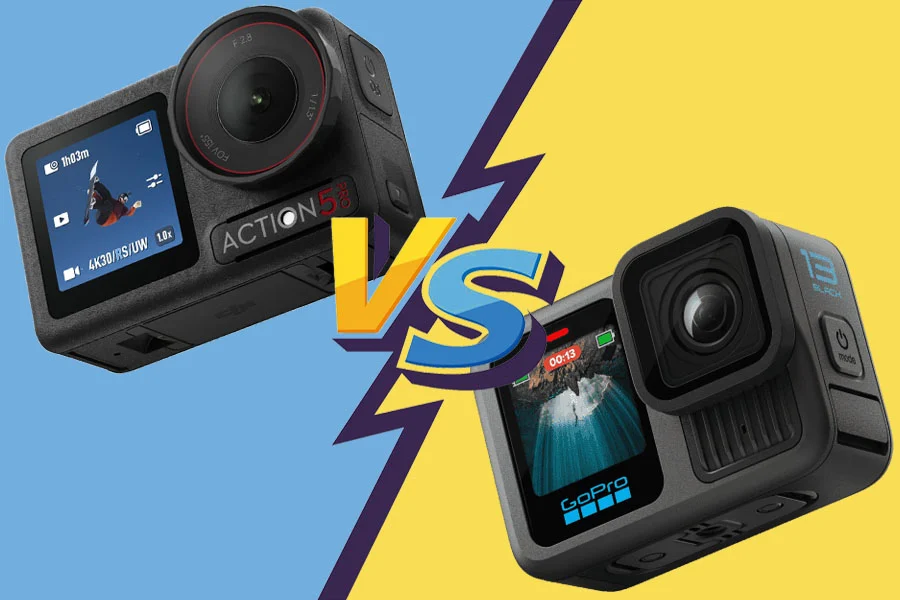
Both cameras are compact, rugged, and built for punishment. The DJI Osmo Action 5 Pro is slightly more compact than the GoPro Hero 13 Black, coming in smaller in height and also lighter at 146g compared to 154g for the GoPro. Maison Du Drone Not a massive difference, but when it’s on your helmet for four hours, every gram counts.
The screens are where DJI really pulls ahead in build quality. Where GoPro uses LCD screens that have remained largely unchanged for several generations, DJI takes a leap forward with OLED technology, offering sharper contrast and more vivid colors. DJI’s front screen is also touch-sensitive, which makes changing modes or adjusting settings much faster without flipping the camera around. Maison Du Drone GoPro’s front screen, to be blunt, is just a viewfinder. You can’t tap on it.
One thing I noticed across a lot of user reviews: people genuinely love the DJI’s magnetic mounting system. It’s quick, it clicks in confidently, and you can swap mounts in seconds. The GoPro’s traditional folding fingers can feel a bit fiddlier, especially when your hands are cold or gloved. Glenn Said GoPro did add a magnetic system to the Hero 13, though, so this gap is closing.
Also Read GoPro Hero 13 vs Hero 12 – Which One Should You Actually Buy?
Battery Life: This Is Where DJI Changes the Conversation
To be honest, battery life is the single biggest practical difference between these two cameras, and it’s not even close.
DJI achieves four-hour battery life, which is double that of the GoPro Hero 13 Black, thanks to an industry-first 4nm chip. TechRadar In real-world usage, that gap feels even more significant. On a day-long hike, you’d only swap the DJI battery once, while the GoPro required three separate battery changes to keep up. Glenn Said
On a 5-hour hike shooting clips periodically, users still had around 30% battery remaining with the DJI, whereas the GoPro required a battery swap or two. The Action 5 Pro also supports fast charging, where roughly 15 minutes of charge provides around 2 hours of 1080p recording time. GoPro Alternatives
If you’ve ever watched a beautiful sunset die on you because your GoPro hit 0% at exactly the wrong moment, you’ll understand why this matters so much. Battery anxiety is real. DJI basically eliminates it.
Image Quality: Daylight vs. Everything Else
Here’s where the debate gets interesting.
In bright, sunny conditions, the GoPro Hero 13 is genuinely beautiful. GoPro’s Hero 13 supports 5.3K video that allows for more cropping flexibility in post-production, and to many eyes the colors look more natural, with warmer skin tones. Engadget If you’re shooting at the beach, on ski slopes in the afternoon, or during golden hour outdoors, GoPro footage has a punchy, crisp quality that’s hard to argue with.
But once the light drops? The DJI takes over. The 4K output from DJI’s larger pixels offers much better dynamic range, which means the camera can cope in conditions beyond daylight, even better thanks to the new SuperNight mode. Digital Camera World
The DJI Osmo Action 5 generally performs better in low-light environments. Tech Times That’s just the reality of having a physically larger sensor gathering more light. If you shoot indoors, at concerts, during early morning trail runs, or underwater at depth, the DJI footage will be noticeably cleaner.
One thing worth mentioning: the Action 5 Pro shoots bright and colorful video straight out of the camera, but to some eyes the colors can look too intense, and skin tones aren’t as warm as on the GoPro Hero 13. However, the ability to shoot 10-bit color in regular mode provides extra room to edit without needing to shoot in D-LogM, which can be tricky for beginners. Engadget
Stabilization: Both Are Excellent, Honestly
This used to be GoPro’s biggest advantage. Not anymore. DJI’s RockSteady 4.0 stabilization is on par with GoPro’s HyperSmooth. The Action 5 Pro even has specialized modes: a Sport mode for high-intensity motion and a Daily mode tuned for walking or low-light situations. On a trail run and off-road cycling, footage came out impressively stable. GoPro Alternatives
If you’re expecting GoPro to win this category by a mile, it doesn’t. Both cameras just work. You can mount either one to a mountain bike handlebar and come back with smooth footage. The gap here is pretty much closed.
Waterproofing and Durability: DJI Goes Deeper
DJI offers waterproofing to 20 meters without a case, compared to GoPro’s 10 meters. Outdoor Tech Lab That’s a genuinely significant difference if you’re a diver, a surfer, or just someone who ends up in unexpected water situations.
In terms of temperature resistance, DJI is also more flexible. The Action 5 Pro can be used in temperatures from -20°C to 45°C, while the GoPro Hero 13 is limited to -10°C to 35°C. Maison Du Drone For anyone doing winter sports or extreme cold weather filming, this matters. A lot.
The GoPro’s Secret Weapon: Modular Lenses
Here’s where GoPro genuinely surprised everyone with the Hero 13. The Hero 13 Black supports optional removable lenses, letting you switch from a typical wide-angle field of view to ultra-wide, macro, and more. The camera can detect these first-party lenses automatically. TechRadar
The Macro lens allowed users to get some incredible close-up shots of forest textures and detail that the DJI simply couldn’t replicate. Glenn Said An anamorphic lens option is also in the mix for filmmakers who want that cinematic widescreen look.
To be fair, most people won’t buy these lens mods. They’re extra money, they’re another thing to carry, and they’re easy to lose. But for creative YouTubers and filmmakers who want options, this is a real advantage GoPro has that DJI doesn’t.
Internal Storage: Small Detail, Big Convenience
The DJI Osmo Action 5 Pro sets itself apart by including 47GB of internal memory in addition to the microSD card slot. It’s a genuine lifesaver for anyone who has ever forgotten their memory card at home or neglected to empty it before an outing. Maison Du Drone
This sounds minor until it saves you from missing a shot. Trust me, it matters.
Price: DJI Offers More for Less
The DJI Osmo Action 5 Pro is priced between $349 and $449, while the GoPro Hero 13 Black sits in the $587-$603 range in some markets, positioning it as a premium, professional-grade tool. Productreviewcrew
In the US and UK, the DJI Standard Combo costs $349/$329, while the GoPro Hero 13 Black is priced at $399/$399. TechRadar The DJI simply gives you more features for a lower price point, which is hard to ignore.
Pros and Cons
DJI Osmo Action 5 Pro
Pros:
- Battery life that actually lasts a full day
- Superior low-light and night shooting
- Deeper waterproofing (20m vs 10m)
- Touch-sensitive front screen
- 47GB built-in internal storage
- OLED displays on both front and back
- Operates in much colder temperatures
- Lower price point
Cons:
- Maximum 4K resolution (no 5.3K like GoPro)
- Colors can feel oversaturated to some users
- No modular lens system
- Less post-production cropping flexibility
- Slower extreme slow-motion compared to GoPro’s 400fps burst mode
GoPro Hero 13 Black
Pros:
- Best-in-class 5.3K resolution
- Modular lens system (macro, ultra-wide, anamorphic)
- Natural, warm color science
- Massive accessory ecosystem
- Excellent daylight footage quality
- Strong HyperSmooth stabilization
Cons:
- Battery life is significantly shorter
- Waterproofing only to 10m
- No touchscreen on front display
- More expensive
- Struggles more in low-light situations
- Limited cold-weather performance
How Does Each Camera Feel to Actually Use?
The GoPro is the better “cinematic” tool for controlled environments, while the DJI is the superior “adventure” tool for unpredictable conditions. Glenn Said That line really captures it perfectly.
If you plan your shoots, shoot in good light, and care about maximum resolution for professional editing, the GoPro feels like the right tool. If you’re throwing a camera in your bag and heading out for a full day not knowing what the light will be like, what the temperature will drop to, or whether you’ll end up in water, the DJI Osmo Action 5 Pro just handles life better.
FAQs: GoPro vs DJI Osmo Action 5
1. Is the DJI Osmo Action 5 Pro better than GoPro Hero 13 for beginners?
For most beginners, yes. The DJI’s dual touchscreens (including a touch-sensitive front display), longer battery life, and built-in storage make it far more forgiving and easy to use day-to-day. You spend less time managing settings and batteries and more time actually filming.
2. Which camera is better for underwater filming?
DJI Osmo Action 5 Pro wins here, and it’s not close. It’s waterproof to 20 meters without any additional case, compared to GoPro’s 10-meter limit. For divers, snorkelers, and surfers, the DJI is the safer, deeper choice.
3. Does GoPro Hero 13 have better video quality than DJI Osmo Action 5 Pro?
In good lighting conditions, GoPro’s 5.3K resolution and color science produce sharper, more detailed footage. But in low light, indoors, or at dawn and dusk, the DJI’s larger sensor captures significantly cleaner footage. It really depends on where you shoot most often.
4. Which has better stabilization: GoPro HyperSmooth or DJI RockSteady?
Both are excellent and largely comparable in real-world use. GoPro’s HyperSmooth has a slight edge in extreme sports scenarios, but DJI’s RockSteady 4.0 with its Sport and Daily modes is impressively smooth. You won’t be disappointed with either.
5. Is the DJI Osmo Action 5 Pro worth it over GoPro for the price?
For most buyers, yes. You get longer battery life, better waterproofing, OLED screens, built-in storage, and superior low-light performance at a lower price. The only real reason to pay more for GoPro is if you specifically need 5.3K resolution or the modular lens system.
6. Can the DJI Osmo Action 5 Pro handle cold weather better than GoPro?
Significantly better. The DJI operates down to -20°C, while the GoPro Hero 13 is rated to -10°C. For skiers, snowboarders, ice fishers, or anyone filming in winter conditions, the DJI is clearly the more reliable choice.
Final Verdict
The honest answer? For most people buying an action camera today, the DJI Osmo Action 5 Pro is the smarter buy. It costs less, lasts longer, dives deeper, handles cold and dark conditions better, and the dual touchscreen setup is genuinely more user-friendly.
GoPro isn’t bad, not even close to it. But in the GoPro vs DJI Osmo Action 5 battle, GoPro is now the specialist’s choice. If you’re a content creator who shoots 5.3K, wants to play with anamorphic lenses, or specifically edits in situations where that extra resolution room makes a real difference in post, the GoPro is worth its price. For everyone else doing day hikes, travel vlogs, water sports, winter adventures, or just casual action shooting, the DJI offers better real-world performance at a lower price.
Pick the GoPro if you’re chasing creative flexibility and maximum sharpness. Pick the DJI if you want a camera that just works, anywhere, all day.
